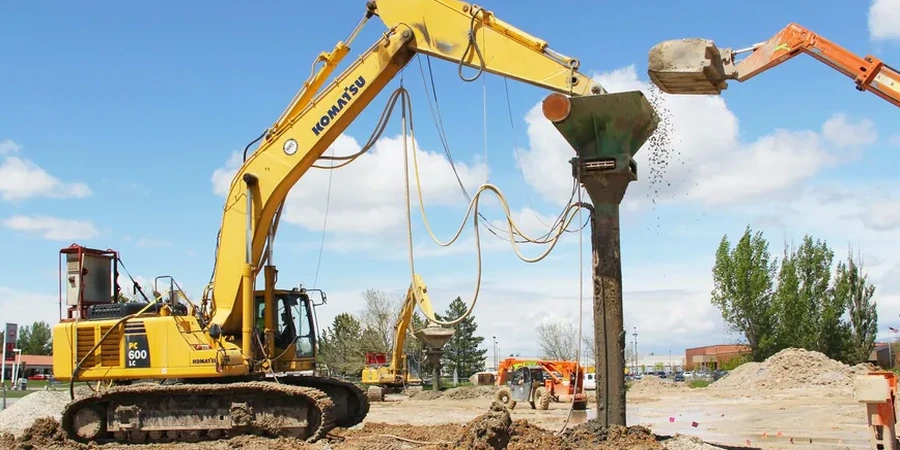
The ground conditions shift noticeably as you move from the historic centre of Celbridge, near Castletown House, down towards the newer developments along the Hazelhatch Road. At the higher elevations you encounter stiff glacial till, but closer to the River Liffey the profile changes to loose alluvial sands and silts—deposits that can extend 4 to 6 metres deep. For any structure transferring heavy loads into these terrace gravels, a vibrocompaction design tailored to the specific grain-size distribution is the first line of defence against differential settlement. We routinely pair this with CPT testing before and after treatment to quantify the improvement in cone resistance, ensuring the design assumptions hold once the vibrator comes off site.
Effective vibrocompaction design in alluvial sands requires matching probe frequency, spacing, and duration to the grain-size curve—not applying a catalogue grid.