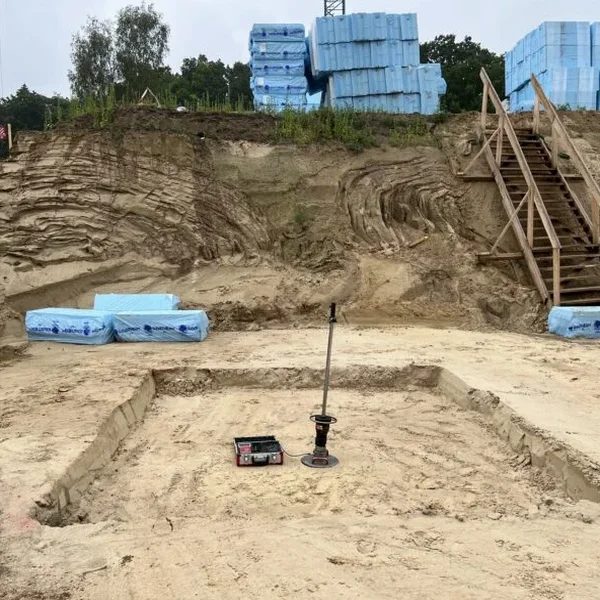
In-situ testing forms the backbone of reliable geotechnical investigation in Celbridge, providing engineers and contractors with direct measurements of ground conditions without disturbing the natural state of the soil. This category encompasses a wide range of field-based assessments that evaluate soil strength, density, permeability, and deformation characteristics right where they matter most — beneath the proposed foundation or infrastructure. In a town experiencing steady residential and commercial growth along the Liffey Valley, understanding the actual behaviour of the ground under load is not just a technical requirement but a safeguard against costly failures and construction delays.
Celbridge sits on a varied geological foundation shaped by glacial activity during the last Ice Age. The underlying bedrock typically consists of Carboniferous limestone of the Lucan Formation, often mantled by glacial till comprising a mix of clay, silt, sand, and gravel. These superficial deposits can vary dramatically over short distances, with pockets of soft alluvial clays near the River Liffey and its tributaries presenting specific challenges for bearing capacity and settlement. Local conditions demand rigorous field density test (sand cone method) assessments to verify compaction levels in granular fills and road bases, particularly where historical floodplain deposits create variable ground profiles.
All in-situ testing carried out in Celbridge must comply with Irish and European standards, most notably the Eurocode 7 framework for geotechnical design (IS EN 1997-1 and IS EN 1997-2), supported by the Irish National Annexes. Specific test methods fall under standards such as IS EN ISO 22476 for penetration testing and IS EN 932 for sampling and compaction evaluation. The National Building Control Regulations and Technical Guidance Document B further mandate that site investigations adequately characterise ground risk, making professional in-situ testing a statutory necessity for planning submissions and building control compliance across County Kildare.
The types of projects requiring in-situ testing in Celbridge span from single-house extensions and housing estates in the peripheral development zones to larger infrastructure works such as road widening, bridge maintenance, and flood defence schemes along the Liffey. Commercial developments in the town centre, school expansions, and sports facility upgrades all rely on accurate field data to design foundations, retaining walls, and drainage systems. Without these tests, assumptions about ground behaviour remain unvalidated, increasing the likelihood of differential settlement, slope instability, or inadequate pavement performance under traffic loading.
In-situ testing measures soil properties in its natural, undisturbed state at the site, preserving stress conditions, moisture content, and fabric. Laboratory tests require extracted samples that may be disturbed during transport and preparation. Field tests like the standard penetration test or cone penetration test provide continuous profiles and immediate results, while lab tests offer more controlled conditions for parameters like shear strength or consolidation under specific stress paths.
Residential projects typically require trial pitting with dynamic probing or standard penetration testing to assess bearing capacity and identify soft layers. The field density test using the sand cone method is frequently specified to verify compaction of granular fill beneath floor slabs and driveways. Permeability testing in accordance with BRE Digest 365 may also be needed where soakaway drainage is proposed, particularly in areas with clay-rich glacial till.
The Liffey Valley's alluvial deposits and glacial till create highly variable ground conditions. Soft clays and silts near watercourses demand careful assessment of undrained shear strength and consolidation potential. Gravelly layers can obstruct penetration testing equipment, requiring heavier rigs or alternative methods. This variability means that a single test location is rarely sufficient; multiple investigation points are needed to capture the lateral and vertical heterogeneity typical of the area.
In-situ testing in Ireland falls under Eurocode 7 (IS EN 1997-1 and 1997-2) with Irish National Annexes, which set out principles for geotechnical investigation and design. Specific test standards include IS EN ISO 22476 for penetration tests and IS EN 932 for sampling. The Building Control Regulations 1997-2014 require adequate site investigation to support planning and construction, and the Health and Safety Authority oversees safety during fieldwork operations.
We serve projects across Celbridge and surrounding areas. More info.