GEOTECHNICAL ENGINEERING
CELBRIDGE
HomeIn-Situ TestingField density test (sand cone method)

Field Density Testing (Sand Cone Method) in Celbridge

Practical geotechnics, field-tested.

LEARN MORE

A rolled fill in Celbridge that hasn't been properly density-tested can settle months after handover, cracking pavement and damaging kerbs. We have seen it happen on sites near the Liffey where the underlying gravels gave a false sense of security. The sand cone test remains the most direct way to verify compaction in the field: you excavate a small hole, measure its volume with calibrated sand, and compare the in-place dry density against the laboratory maximum from a Proctor curve. In Celbridge, where the subsoil shifts between the well-drained limestone tills of the Donore area and the softer alluvial silts along the R403 corridor, a single Proctor reference without site-specific verification rarely tells the full story. We run the test to ASTM D1556 / D1557, pairing it with a Proctor curve determined from material sampled at the same lift, so the compaction percentage you get reflects actual site conditions and not a generic lab benchmark.

A sand cone test is only as reliable as the calibration that precedes it — skip the morning sand-weight check and the whole day's results are suspect.
Our service areas

How we work

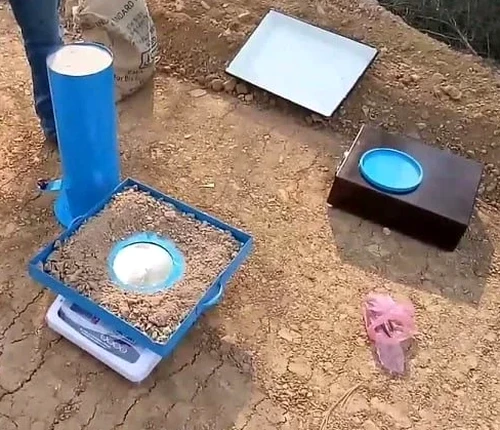
The sand cone apparatus we deploy is straightforward but unforgiving of shortcuts: a one-gallon threaded jar filled with uniformly graded Ottawa sand or a local equivalent, a precision-machined aluminum cone, and a 6.5-inch base plate that seats flush on the compacted lift. Calibration of the sand density is repeated on every site because humidity and handling can shift the unit weight by half a pound per cubic foot, and in Celbridge — where morning mist off the Liffey valley lingers well into the working day — that is enough to throw a 95 percent compaction spec out of compliance. The field procedure excavates roughly 700 to 1,100 cubic centimetres of material through the base plate opening, recovering all the soil in a sealed bag for mass determination. Moisture content is run on a representative portion using a gas burner or microwave in the site cabin, and the corrected dry density is calculated within fifteen minutes of pulling the sample. When the fill contains cobbles or crushed stone larger than 1.5 inches, the test hole is oversized and the volume correction follows the AASHTO T-191 appendix, which we document photographically for the client's records.
Field Density Testing (Sand Cone Method) in Celbridge
Technical reference — Celbridge

Site-specific factors

In Celbridge, many of the residential schemes built over the past five years sit on glacial till that drains reasonably well but can contain pockets of soft, over-consolidated clay that look firm on the surface. A grader operator who runs a smooth-drum roller until refusal can still leave a lift at 88 percent of modified Proctor if the moisture content is four points below optimum — and a nuclear gauge reading can be off by several percentage points if the organic content or ironstone cobbles in the till haven't been accounted for. We have re-tested layers that passed on the nuclear gauge and found them deficient by sand cone, which is why the sand cone method remains the referee test in any specification dispute. Under-compacted fill in this part of County Kildare means differential settlement under the shallow strip footings typical of estate housing, and once the blockwork cracks, remediation costs far exceed repeat density testing. A CPT investigation can help map the lateral extent of weak zones if poor compaction is suspected over a larger footprint.

Need a geotechnical assessment?

Reply within 24h.

Email: contact@geotechnical-engineering.co

Regulatory framework

ASTM D1556-15e1: Standard Test Method for Density and Unit Weight of Soil in Place by Sand-Cone Method, ASTM D1557-12e1: Standard Test Methods for Laboratory Compaction Characteristics of Soil Using Modified Effort, AASHTO T-191: Standard Method of Test for Density of Soil In-Place by the Sand-Cone Method, Irish Standard S.R. 21:2014 (Guidance on the use of Eurocode 7 with the Irish National Annex)

Reference parameters

ParameterTypical value
Test standardASTM D1556 / AASHTO T-191
Reference Proctor methodASTM D698 or D1557 per specification
Base plate diameter6.5 in (165 mm)
Typical test hole depth4 to 6 in (100–150 mm), matching lift thickness
Calibration sandGraded Ottawa sand, bulk density verified daily
Minimum in-place density reported90 % to 100 % of laboratory maximum
Frequency guidance (earthworks)One test per 1,500–2,500 ft² per lift
Reporting turnaroundField result immediate; signed PDF within 24 h

Frequently asked questions

How long does a single sand cone density test take on site in Celbridge?

Plan on about 20 to 25 minutes per location once the technician is set up. The excavation and sand-pouring steps take roughly 10 minutes, and the moisture-content determination with a gas burner or microwave adds another 10 to 15 minutes. The density calculation is immediate, so you have a pass-or-fail answer before the roller moves to the next lift.

What does field density testing with the sand cone method cost in the Celbridge area?

For sites in Celbridge, a single sand cone test typically runs between €110 and €140, depending on the number of tests booked in a day and whether a separate Proctor curve is required. A full-day rate for multiple lifts works out more economical, and we include the daily sand calibration in the price so there are no hidden lab charges.

Can the sand cone test be used on crushed stone or Type 1 subbase in Celbridge road projects?

It can, with a few adjustments. For material with particles larger than 37.5 mm, the test hole is excavated oversized and the volume of the removed oversize is measured separately. The measured in-place density is corrected using ASTM D4718 to account for the rock fraction. On road jobs along the M4 approach or in Celbridge industrial estates, we often run parallel sand cone and nuclear gauge checks to calibrate the gauge for the specific aggregate source.

What moisture condition gives the most reliable sand cone result in the till soils around Celbridge?

The test is most repeatable when the fill is within about 2 percent of optimum moisture content. If the soil is too dry, the hole walls collapse during excavation; too wet, and the fine-grained matrix deforms under the base plate. In the limestone till common around Celbridge, optimum is often between 10 and 13 percent, and we adjust the field compaction moisture window based on the lab Proctor curve run on the actual borrow-source material.

Location and service area

We serve projects across Celbridge and surrounding areas.

View larger map