GEOTECHNICAL ENGINEERING
CELBRIDGE
HomeLaboratoryTriaxial test

Triaxial Testing for Geotechnical Analysis in Celbridge

Practical geotechnics, field-tested.

LEARN MORE

Celbridge sits at roughly 55 metres above sea level, straddling the River Liffey as it cuts through the limestone and shale bedrock of northeast Kildare. The town’s population has passed the 20,000 mark, driving a steady demand for residential and commercial development on the alluvial gravels and glacial tills that line the valley. In our laboratory, we see a direct link between this growth and the need for reliable triaxial testing: foundation designs here cannot rely on rule-of-thumb values when dealing with silty clay layers that vary in strength across a single site. The triaxial test gives us the drained and undrained shear parameters that structural engineers need to avoid overdesign or, worse, an underdesigned footing. When a site investigation brings us Shelby tube samples from a new housing scheme off the Maynooth Road, our first step is to assess the effective stress response using consolidated-undrained triaxial compression, because the Liffey’s historic floodplain deposits behave very differently under load than the stiffer till upslope. For deeper infrastructure, we often pair the CPT testing data with laboratory-derived strength envelopes to calibrate the in-situ cone resistance against the soil’s actual friction angle, a workflow that saves considerable time on large Celbridge projects.

A single triaxial test on a properly saturated specimen tells us more about a soil’s real behaviour than twenty index tests combined.
Our service areas

How we work

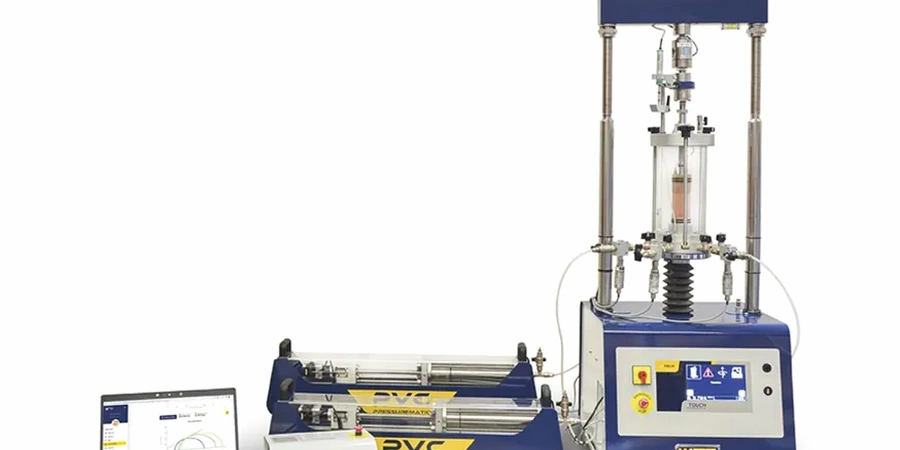
The heart of our triaxial setup is a servo-controlled load frame paired with three independent pressure-volume controllers that manage cell pressure, back pressure, and pore water pressure measurement. A typical Celbridge sample arrives as a 100 mm diameter specimen trimmed from a thin-walled tube taken from the boulder clay at depths between 3 and 8 metres. We mount the specimen inside a latex membrane, place it on a porous stone, and seal it within the triaxial cell before filling the chamber with de-aired water. Saturation is the make-or-break phase: we ramp back pressure in steps while monitoring Skempton’s B-value until it exceeds 0.95, which in the silty matrix common around Celbridge can take up to 72 hours. Consolidation follows under the estimated in-situ effective stress, matching the overburden pressure at the sampling depth. The shearing stage applies axial strain at a rate controlled by the drainage condition—0.05 mm/min for a drained test on silt, or ten times faster for an undrained run where we track excess pore pressure. Throughout the test, the data acquisition system logs deviator stress, axial strain, and volume change at one-second intervals, building a full stress-strain curve that reveals the soil’s peak strength and post-peak behaviour. On multiple occasions, we have run grain size analysis in parallel to correlate the shear response with fines content, because the transition from a well-graded sandy gravel to a clayey silt completely changes the failure envelope in Celbridge’s glacial deposits.
Triaxial Testing for Geotechnical Analysis in Celbridge
Technical reference — Celbridge

Site-specific factors

Celbridge’s expansion from an eighteenth-century mill village into a commuter town has pushed new construction onto land that was once water meadow or gently sloping farmland. This shift matters geotechnically because the shallow groundwater table and interbedded soft lenses within the till create a risk profile that standard penetration testing alone cannot resolve. A site investigation that stops at SPT blow counts will miss the low effective friction angle of a saturated silt layer until the excavation is already open and sidewalls begin to ravel. What we most often encounter in this part of County Kildare is a strength anisotropy problem: the horizontal bedding of glaciolacustrine deposits produces a shear plane that is weaker than the vertical axis tested in a simple unconfined compression. Triaxial testing with pore pressure measurement captures this behaviour directly, producing Mohr-Coulomb parameters that feed into slope stability models for cut-and-fill operations or retaining wall designs along the Liffey corridor. Skipping this step on a Celbridge site with more than two metres of soft alluvium is a decision that has led to costly remedial grouting on at least three projects we have reviewed in the last five years.

Need a geotechnical assessment?

Reply within 24h.

Email: contact@geotechnical-engineering.co

Regulatory framework

ASTM D4767-11 (CU with pore pressure), ASTM D7181-20 (CD test), BS 1377-8:1990, ISRM suggested methods for rock triaxial, EN 1997-2:2007 (Eurocode 7, ground investigation)

Reference parameters

ParameterTypical value
Test types availableUU, CU, CD, multi-stage
Specimen diameter (standard)38, 50, 70, 100 mm
Maximum cell pressure2,000 kPa
Saturation criterion (B-value)> 0.95 per ASTM D4767
Axial strain rate range0.001 to 10 mm/min
Deviator load capacity50 kN
Pore pressure transducer accuracy±0.1 kPa
Data logging interval1 second (shear phase)

Frequently asked questions

What does a triaxial test cost for a project in Celbridge?

The laboratory fee for a standard triaxial test programme in Celbridge generally falls between €1,730 and €2,210, depending on the number of specimens and whether you require a single-stage or multi-stage procedure. A typical three-specimen CU set with B-value checks and full reporting sits near the middle of that range. Transport of Shelby tubes from the site to our facility is quoted separately based on distance, and we are happy to provide a fixed-price proposal once we know the borehole depths and target strata.

Which type of triaxial test is right for the boulder clay found in Celbridge?

The lodgement till that underlies much of Celbridge is a stiff, low-permeability material that is best characterised with a consolidated-undrained test with pore pressure measurement. Because it contains a mix of silt, clay, sand, and occasional cobbles, the drainage path is short enough that an undrained test captures the worst-case condition during construction loading. We recommend CU with at least three confining pressures to define the Mohr-Coulomb envelope, and if the sample is fissured—common in weathered upper till—we increase the specimen diameter to 100 mm to include a representative fracture network.

How long does a triaxial testing programme take from sample receipt to final report?

A complete triaxial programme on three specimens from a Celbridge site typically requires seven to ten working days. Saturation alone can consume two to three days for the low-permeability silts we frequently receive, because we wait until the B-value stabilises above 0.95. Consolidation adds another 24 hours per specimen, and drained shearing runs at a slow rate that takes a full day. We issue a preliminary data sheet as soon as the last test finishes, with the interpretive report—including stress paths, p-q diagrams, and recommended design parameters—following within two working days.

Location and service area

We serve projects across Celbridge and surrounding areas.

View larger map