GEOTECHNICAL ENGINEERING
CELBRIDGE

Geotechnical Engineering in Celbridge

Practical geotechnics, field-tested.

LEARN MORE

In Celbridge, overlooking the Liffey valley, the ground beneath your feet tells a story of glacial retreat and river deposition. The terrain shifts from limestone-derived tills on the higher ground near Castletown to soft alluvial silts closer to the riverbank. A generic desk study will not capture these transitions. We regularly encounter projects where the bearing stratum varies by over 150 kPa within a single site footprint. A soil mechanics study conducted by someone who knows the local drift geology is what separates a straightforward foundation pour from a costly re-design six weeks into the build. Our team has logged boreholes across north Kildare and we understand how the winter water table here, often perched within the upper two metres, governs the effective stress parameters you need for your retaining wall calculations.

In Celbridge's glacial terrain, the difference between a 600 mm strip footing and a costly piled solution often comes down to a single, well-interpreted triaxial test.
Geotechnical Engineering in Celbridge
Technical reference — Celbridge

Our service areas

Local geology

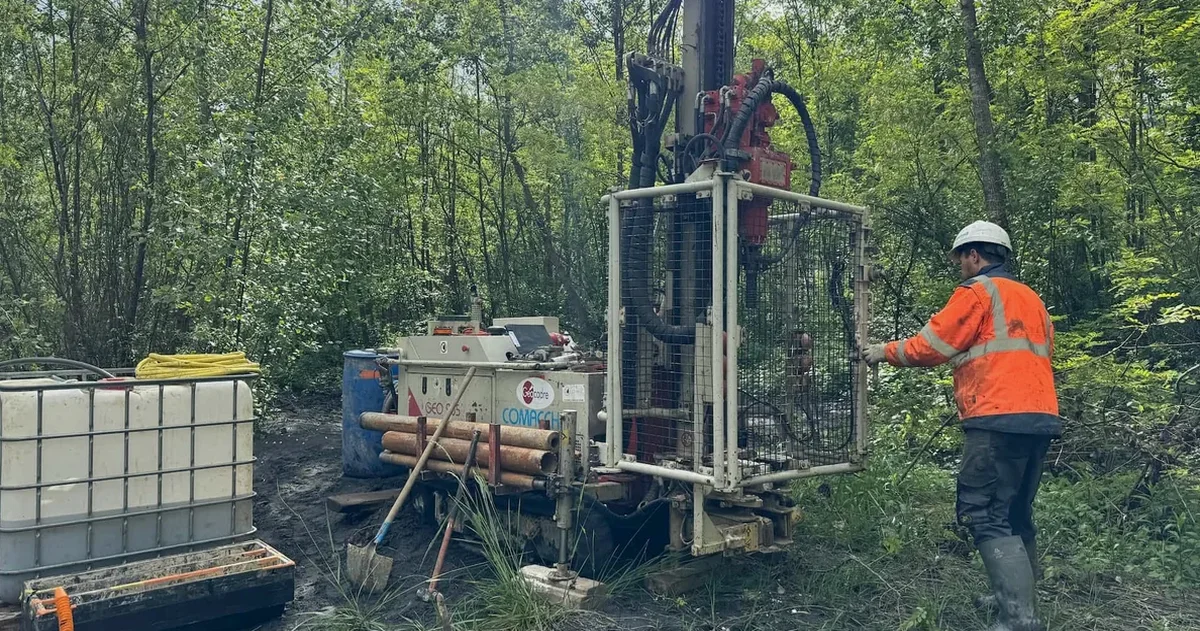
Eurocode 7, specifically I.S. EN 1997-2:2007, mandates a rigorous ground investigation for any structure in Ireland. In Celbridge, this means going beyond a simple SPT count. The limestone till here contains cobbles and boulders that can mislead dynamic probing. We insist on a combination of trial pitting for visual profiling and rotary core drilling where refusal is encountered. Our laboratory, accredited to ISO 17025, runs classification tests, Atterberg limits, and strength testing, all referenced against the current British Standards and IS EN ISO documents. For projects near the river's edge, where soft alluvium is present, the integration of our soil mechanics data with a CPT test can provide a near-continuous profile of undrained shear strength, helping to avoid over-excavation and minimising concrete backfill.

Regulatory framework

I.S. EN 1997-1:2004 (Eurocode 7: Geotechnical design), I.S. EN 1997-2:2007 (Ground investigation and testing), I.S. EN ISO 17892 series (Laboratory testing of soil), BS 5930:2015 (Code of practice for ground investigations)

Need a geotechnical assessment?

Reply within 24h.

Email: contact@geotechnical-engineering.co

Why choose us

The principal geotechnical risk in Celbridge is the spatial variability of the subsoil. A borehole on one side of a site may hit dense till at a metre depth, while twenty metres away, a pocket of soft, laminated clay extends to three metres. Differential settlement is a real threat if the foundation design does not account for this. The second risk is water. The till is often a perched aquifer, and excavations can fill rapidly after heavy rain, which is not uncommon in Kildare. This softens the formation level and can reduce the bearing capacity by half if not managed correctly. We quantify these risks through a targeted sampling programme, testing the remoulded strength of the clay to understand its sensitivity, and providing clear recommendations on groundwater control during construction.

Reference parameters

ParameterTypical value
Typical Bearing Capacity (Glacial Till)125 - 250 kPa (Allowable)
Undrained Shear Strength (Alluvium)15 - 40 kPa
Effective Friction Angle (Till)32° - 36° (Peak)
Coefficient of Volume Compressibility (mv)0.05 - 0.25 m²/MN
Soil Classification (Typical)Sandy gravelly CLAY / Silty SAND
Winter Groundwater Level0.8 - 2.5 m bgl

Frequently asked questions

What is the typical cost of a soil mechanics study for a single house in Celbridge?

For a standard residential site in Celbridge, a full soil mechanics study including a trial pit, laboratory classification, and a factual report typically falls between €2,450 and €4,470. The final figure depends on the number of exploratory points required and the extent of strength testing needed.

How deep do you need to investigate for a two-storey extension in this area?

For a two-storey extension on the glacial till common in Celbridge, we generally investigate to a depth of 3.0 to 4.0 metres. This gets us well below the zone of seasonal moisture influence and allows us to assess the consistency of the till with depth. If the trial pit encounters soft alluvium, we will extend the investigation deeper.

Do you test for pyrite in the fill material?

Yes, we can arrange for chemical testing of the aggregate fill for total sulfur content in accordance with I.S. EN 1744-1. While the natural limestone till in Celbridge is generally not problematic, crushed stone fill imported to the site can sometimes contain reactive pyrite, and we always recommend testing if hardcore is present.

How long does the laboratory testing take after the site investigation?

Standard classification and strength tests in our ISO 17025 accredited lab are typically completed within 10 to 12 working days from the date of sampling. Consolidation tests take slightly longer, around 14 days, due to the incremental loading procedure. We can fast-track the report if the project schedule is tight.

Location and service area

We serve projects across Celbridge and surrounding areas.

View larger map